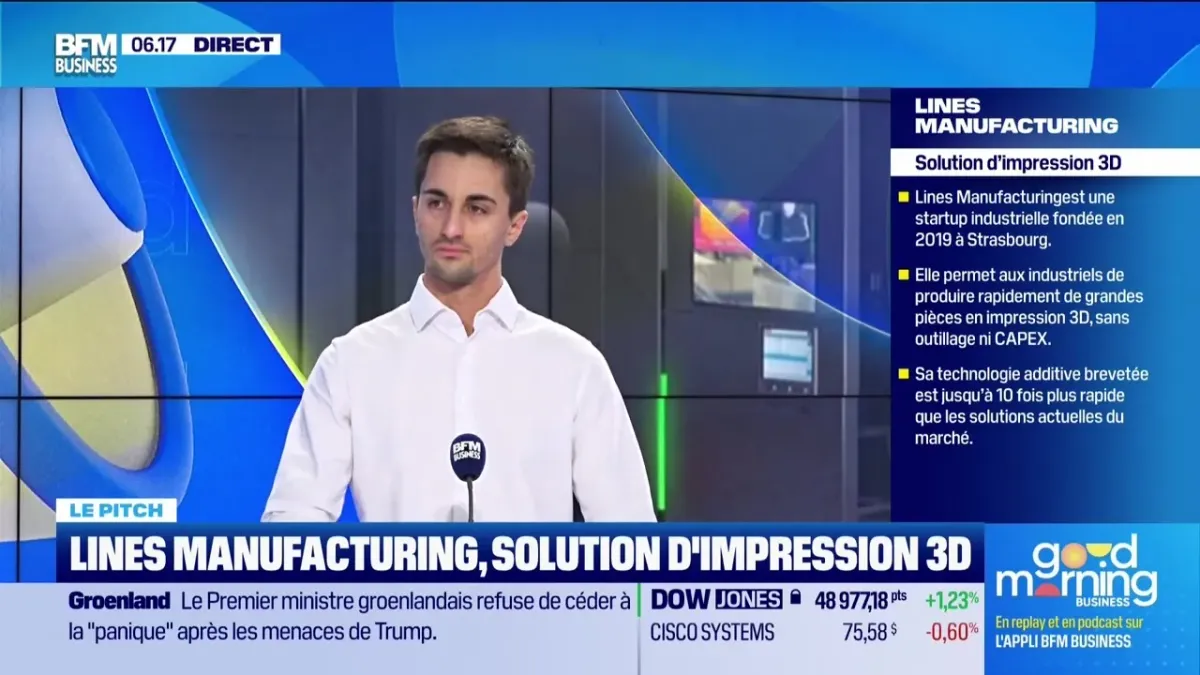

Large-scale additive manufacturing reached a mainstream French audience this year when Lines Manufacturing CEO Niels Pernoux appeared on BFM TV — invited by journalist Laure Closier to discuss industrial 3D printing, the reindustrialisation of France, and Lines' approach to manufacturing large parts at series production scale.
BFM TV's morning edition is one of France's most-watched business and economic programmes. Being invited onto that platform to talk about deeptech manufacturing is a reflection of the growing interest — from investors, industrialists, and policymakers — in technologies that can genuinely change how France produces things.
Laure Closier's questions cut straight to the point: What does Lines Manufacturing actually do? Who are your clients? How does large-scale additive manufacturing compete with traditional production methods? And why should France be paying attention?
One of the challenges of communicating about an emerging industrial technology on a general business news channel is finding the right level of explanation. Too technical, and you lose the audience. Too simplified, and you risk misrepresenting the genuine complexity — and genuine capability — of what you're building.
Niels focused on three key messages: first, that Lines' FGF technology enables the production of polymer parts measuring up to several cubic metres, in materials that can withstand the demands of industrial use — something that conventional 3D printing simply cannot do. Second, that this opens up entirely new possibilities for sectors like rail, marine, automotive, and defence — enabling on-demand production of large structural components, replacement parts, and tooling without the cost and lead times of traditional mould-based manufacturing. And third, that this technology is French — developed in Alsace, scaling from Eschau — and represents exactly the kind of high-value industrial deeptech that a reindustrialisation strategy should be built around.
This BFM TV appearance is part of a broader effort by Lines Manufacturing to make our work visible and understandable to a wider audience — not just the specialists who attend Formnext or the engineers who read technical trade press, but the business leaders, investors, and decision-makers who are thinking about the long-term future of French and European industry.


