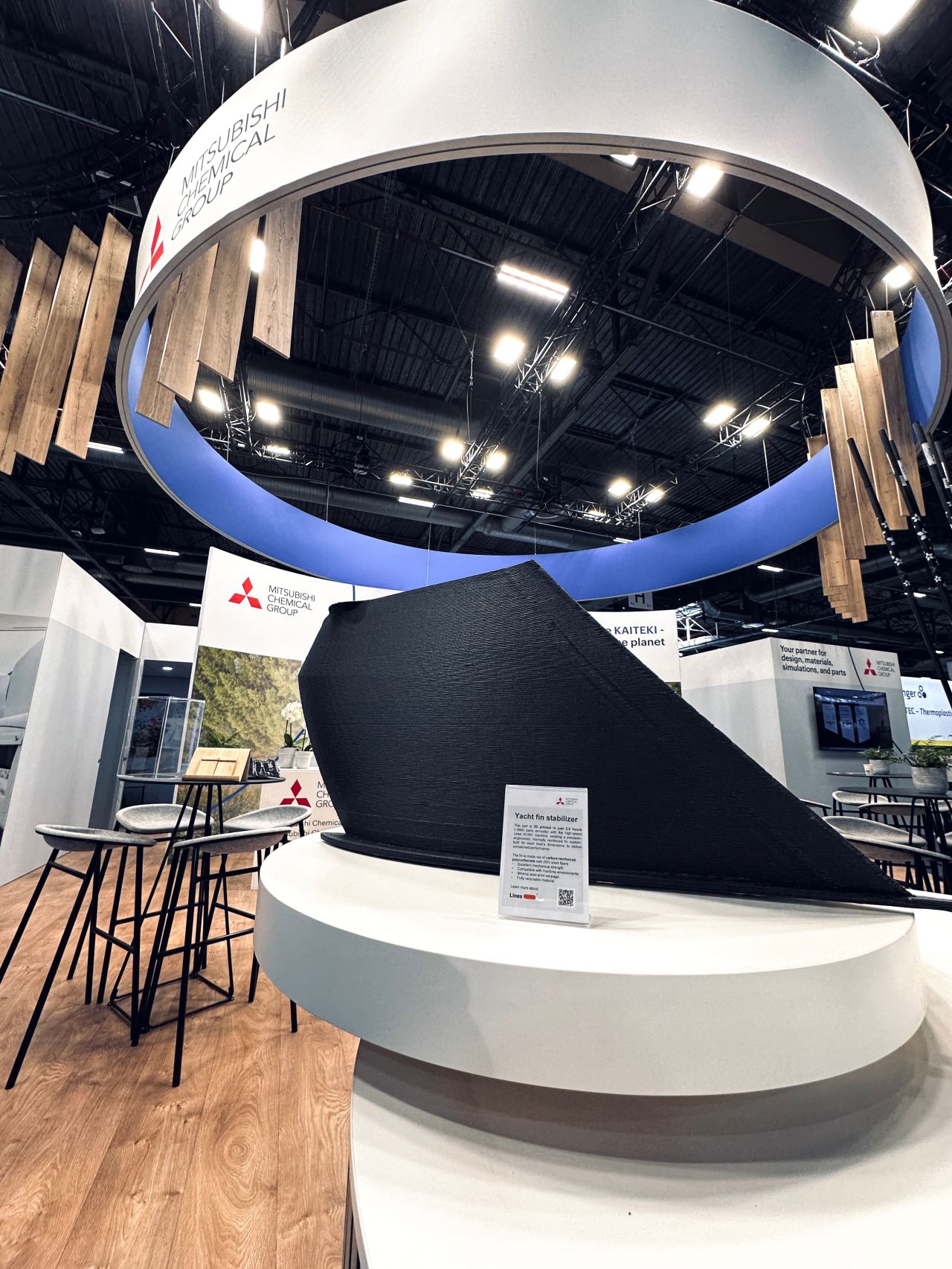

JEC World is the world's most important event for composite materials and technologies — the place where aerospace engineers, naval architects, automotive specialists, and materials scientists converge to define the next generation of high-performance parts and structures. This year, Lines Manufacturing was proud to exhibit at JEC World 2025 on a shared stand with Mitsubishi Chemical Group (MCG) — our strategic materials partner — to demonstrate how large-scale additive manufacturing is opening a new chapter for advanced composite applications.
The partnership between Lines Manufacturing and Mitsubishi Chemical Group is built on a shared conviction: that the combination of Lines' high-speed FGF technology and MCG's advanced thermoplastic compound expertise creates a uniquely powerful platform for industrial applications that conventional manufacturing processes cannot address economically or technically.
MCG is one of the world's leading suppliers of high-performance polymer compounds — including carbon fibre-reinforced grades specifically engineered for demanding structural applications. Having them as a materials partner means that Lines' machines are not just fast and large — they are fed with materials formulated to deliver the mechanical properties that aerospace, marine, and mobility applications require.
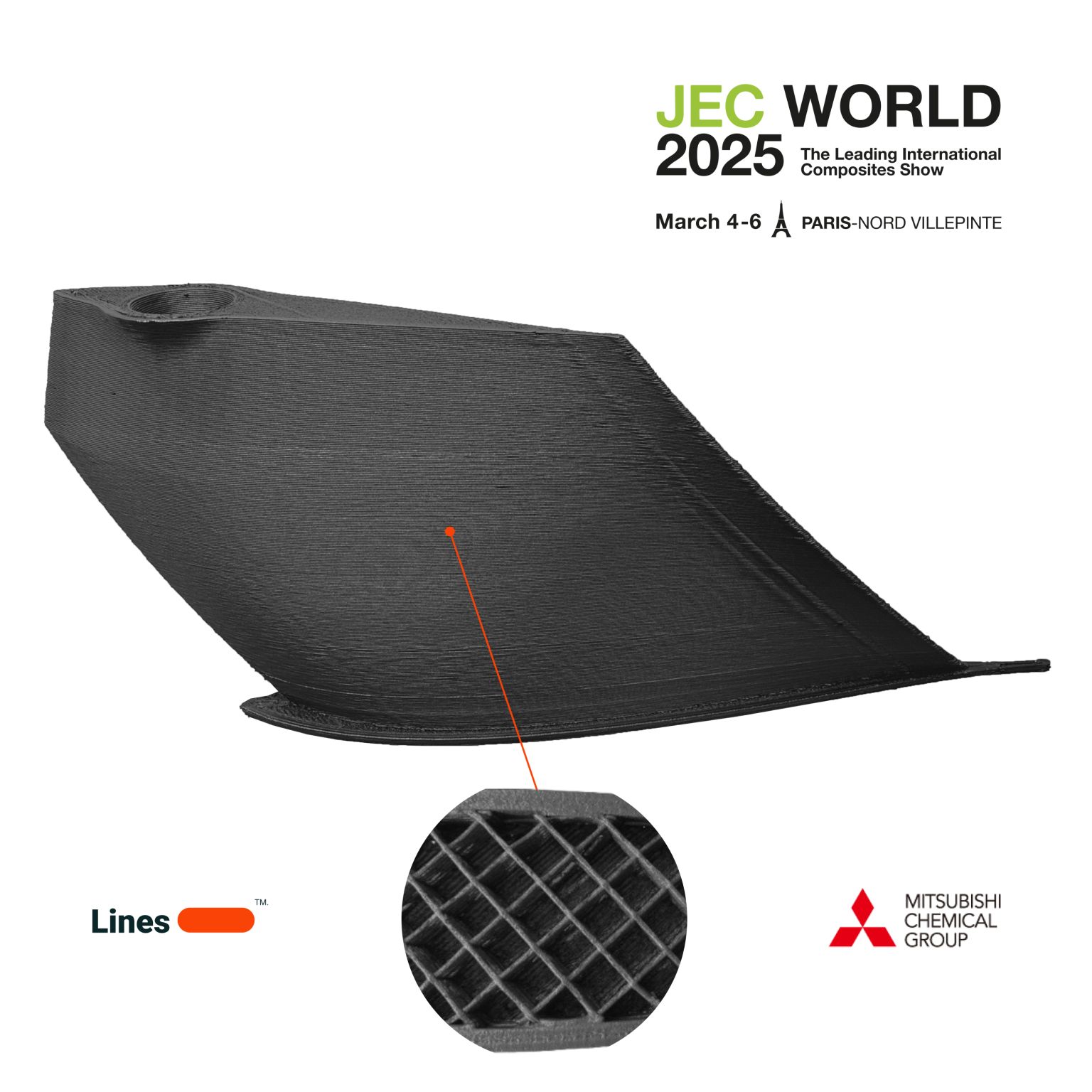
The centre piece of our joint exhibit was a large-format marine yacht stabilizer, produced entirely on a Lines FGF system in 20% carbon fibre-reinforced polycarbonate (PC-CF20) — a high-performance compound supplied by Mitsubishi Chemical Group.
This part tells a compelling story in a single object. Yacht stabilizers are large, geometrically complex components that must combine structural rigidity, dimensional stability, and resistance to the marine environment — properties that polycarbonate composites are well-suited to deliver, and that large-scale additive manufacturing is uniquely positioned to produce without the cost and lead time of conventional moulding.
The choice of PC-CF20 was deliberate. Carbon fibre reinforcement at 20% loading significantly increases the stiffness-to-weight ratio compared to unreinforced thermoplastics, enabling the production of structural components that can bear real mechanical loads — not just decorative or enclosure parts. The result is a part that demonstrates, tangibly and at full scale, that high-speed large-scale additive manufacturing is no longer limited to generic polymers: it is capable of processing advanced composite compounds with the precision and repeatability that industrial applications demand.
The composites industry has traditionally relied on labour-intensive, tooling-dependent processes — hand layup, resin transfer moulding, compression moulding — that deliver exceptional performance but impose significant constraints on cost, lead time, and design flexibility. For high-volume series production, these methods remain the standard. But for low-to-medium volume applications, complex geometries, large parts, and iterative development, they create friction that slows innovation.
Large-scale additive manufacturing with reinforced thermoplastic compounds offers a genuine alternative path:
– No tooling required — eliminating the months and tens of thousands of euros needed to produce a mould for a large structural part.
– Design freedom at scale — complex internal geometries, variable wall thickness, integrated features — all achievable without additional tooling cost.
– Faster time-to-part — from digital file to finished component in days, not months.
– Material performance — with carbon or glass fibre reinforcement, printed parts achieve mechanical properties approaching those of conventional composite components for many structural applications.
– Sustainability — thermoplastic composite parts can, in principle, be reprocessed at end of life, supporting circular economy objectives that are increasingly central to aerospace and marine procurement requirements.
JEC World 2025 attracted tens of thousands of professionals from across the global composites ecosystem. For Lines Manufacturing, the show was an opportunity to connect with an audience that is highly technically sophisticated — materials engineers, structural designers, production managers — and to demonstrate that additive manufacturing with advanced composite compounds is no longer a laboratory curiosity but a production-ready technology.
The response to the yacht stabilizer was exactly what we hoped for: detailed, technically demanding questions about material properties, layer adhesion, dimensional accuracy, post-processing requirements, and certification pathways. These are the right questions — they tell us that the industry is taking this technology seriously and evaluating it with the rigour it deserves.
We are grateful to Mitsubishi Chemical Group for the exceptional partnership, for the material expertise they bring to every project, and for the shared vision that makes this kind of demonstration possible. The future of composite manufacturing will be written by partnerships like this one — where material science and manufacturing technology advance together.
Interested in exploring composite additive manufacturing for your application? Contact us at hello@lines-manufacturing.com — our team is ready to discuss your project.


